The Lundy Navigator project is an AI-powered knowledge assistant designed for real estate Multiple Listing Service (MLS) organizations to streamline the retrieval of information from vast internal documentation.
Core Functionality:
The application leverages Retrieval-Augmented Generation (RAG) to provide accurate, cited answers from trusted internal sources. Its primary functions include:
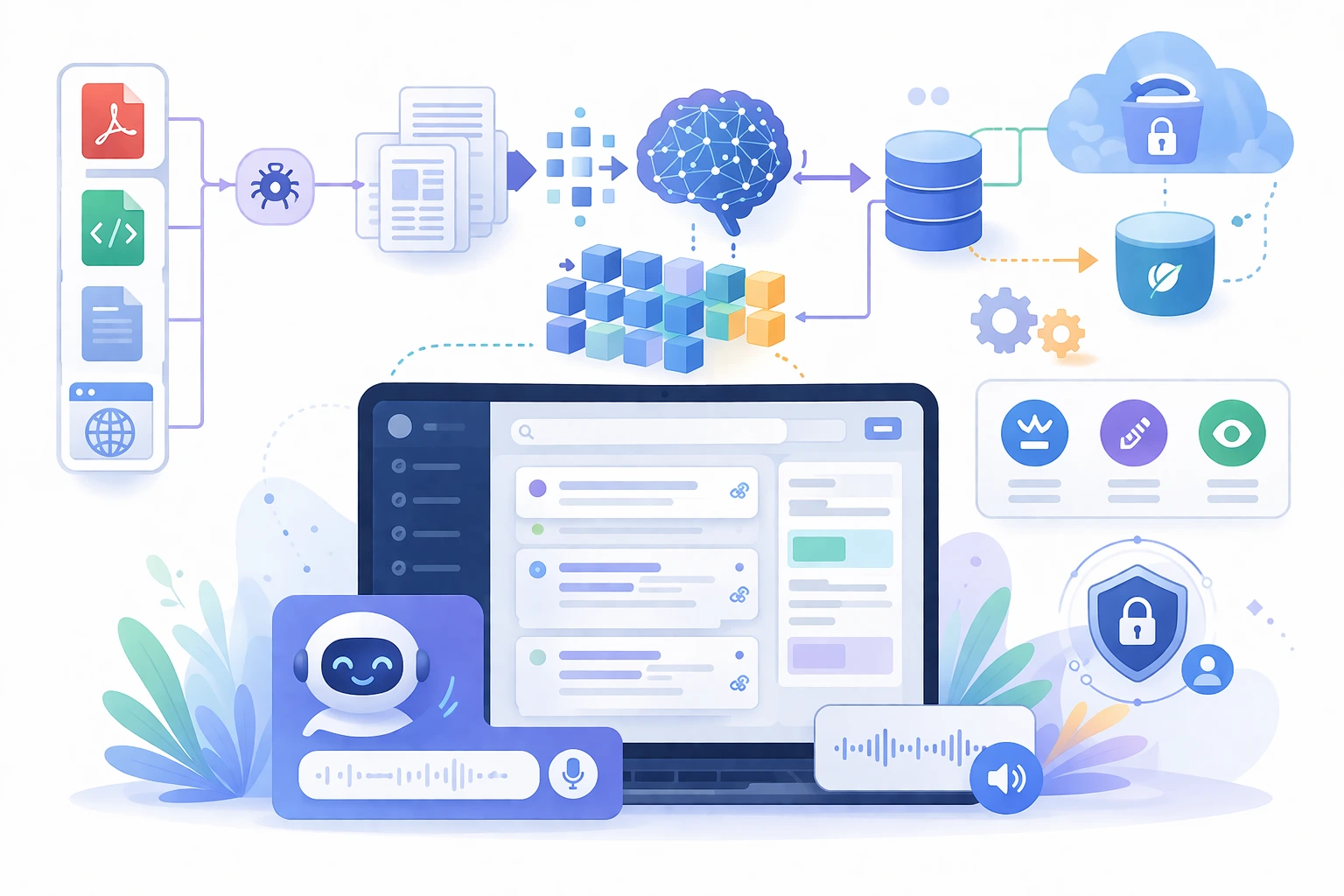
- Data Ingestion: Supports manual uploads of PDF, HTML, and Text files, as well as an automated, scheduled web crawler to pull content from internal websites.
- Document Processing: Chunks documents into meaningful paragraphs, prepends contextual location data, and converts them into vector embeddings for storage.4
- Intelligent Retrieval: Performs vector searches to provide direct answers to user queries, complete with links to the exact document sections used as sources.
- Multimodal Interaction: Includes support for voice-to-text queries and audible voice output for hands-free use.
- User Management: Features a multi-tiered dashboard (Admin, Editor, Reader) with role-based access control.
- Asynchronous Scaling: A scalable system (v3) uses asynchronous job queues to handle large files and high-volume processing simultaneously.
Technical Stack
The project utilizes a robust modern technology stack:
- Backend: Python Django and Django REST Framework for the core API and application logic.
- Frontend: Next.js and React for the customer-facing dashboard and user interfaces.
- AI & LLM:
- Models: GPT-4, GPT-4o, and GPT-4o-mini.
- Embeddings: OpenAI text-embedding-3 (large and small).
- OCR: PaddleOCR for multilingual text extraction.
- Data Storage:
- Relational: PostgreSQL.
- NoSQL: MongoDB.
- Vector Database: pgvector within Postgres.
- Infrastructure (AWS):
- Compute: Lambda and EC2
- Storage: S3 for document and artifact storage.
- Messaging: SQS, Redis, and Celery for task queuing and event handling.
- Monitoring: CloudWatch for logging.
- Security: Keycloak (OIDC) for authentication and Role-Based Access Control (RBAC), PropelAuth for session management, and encryption at rest