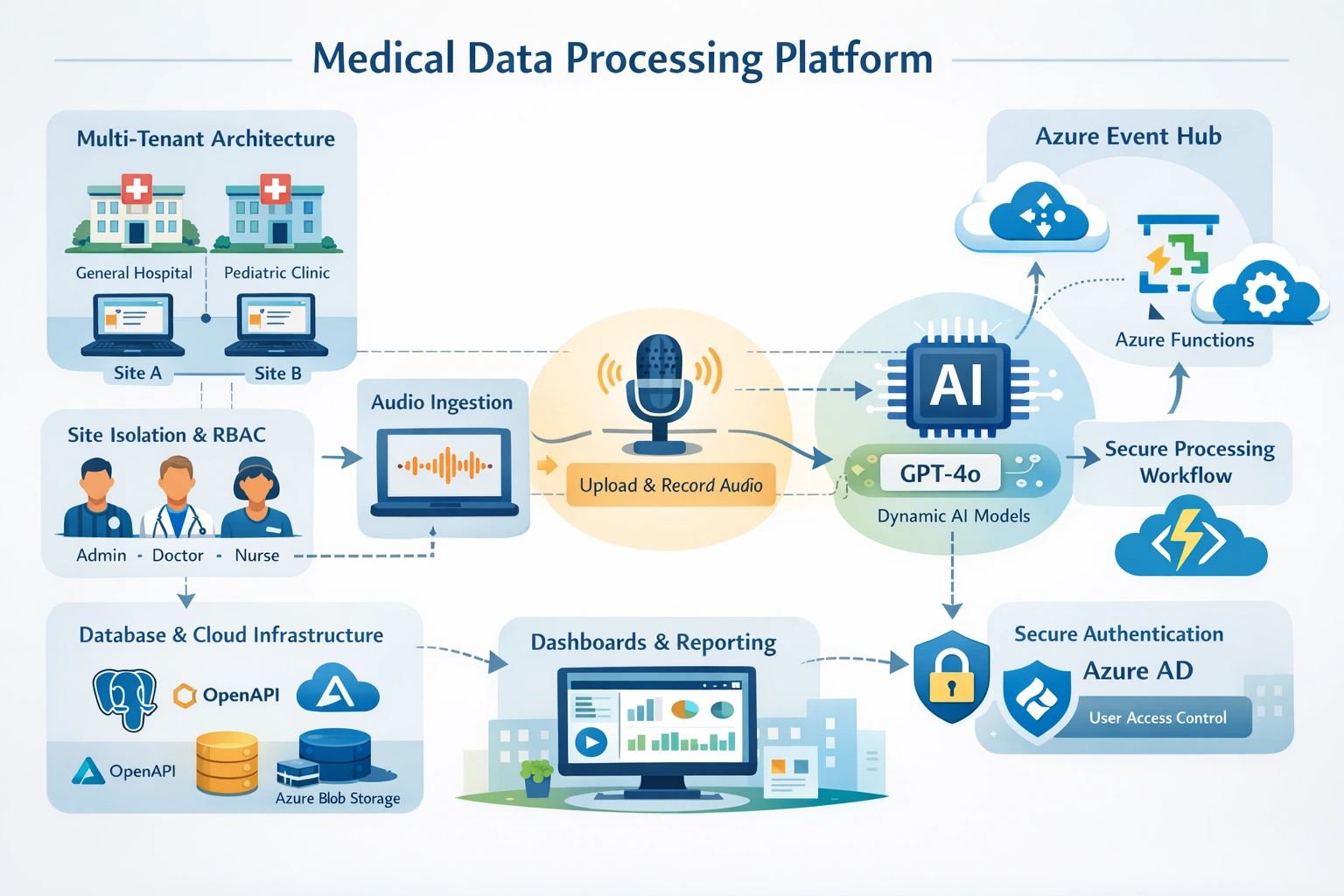
The project involves developing a multi-tenant software system designed for medical or clinical environments to handle patient information processing. It focuses on automating the extraction of patient data from audio recordings using machine learning and routing that data securely based on specific site configurations (e.g., general hospitals vs. pediatric sites).
Core Functionality:
- Multi-Tenant Architecture: A base setup that uses partitioning to isolate data by site_id, ensuring users only access records belonging to their specific site.
- Audio Processing & Ingestion: A voice-activated (VAD-enabled) interface for recording, uploading, and playing back audio files.
- Machine Learning Integration: Dynamic loading of AI prompts and models (e.g., GPT-4o) from a database to categorize and extract patient data from audio.
- Site Configuration Framework: A management system to customize AI behavior (prompts, thresholds, model selection) for different clinical sites.
- Azure-Based Event Routing: Automated workflows where audio uploads trigger events in Azure Event Hub, which are then processed by Azure Functions for transcription and LLM-based analysis.7
- Dashboards & Reporting: Frontend interfaces for site-level metrics (token usage, patients processed) and administrative tools for billing and audit logging.8
- Security & Access Control: Role-based access control (RBAC) and authentication integrated with Microsoft Azure AD to manage user permissions and data isolation.
Technical Stack:
- Back End: Python.
- Front End: Python Django (using Django templates and JavaScript for the audio recorder).
- APIs: OpenAPI.
- Cloud Infrastructure: Microsoft Azure (Blob Storage, Event Hub, and Azure Functions).
- Database: PostgreSQL.
- AI/ML: OpenAI (including models like GPT-4o or GPT-3.5).
- Authentication: Microsoft Azure AD (OIDC login flow).